
OUR TECHNOLOGIES
We evaluate enzymatic activity at single protein level.
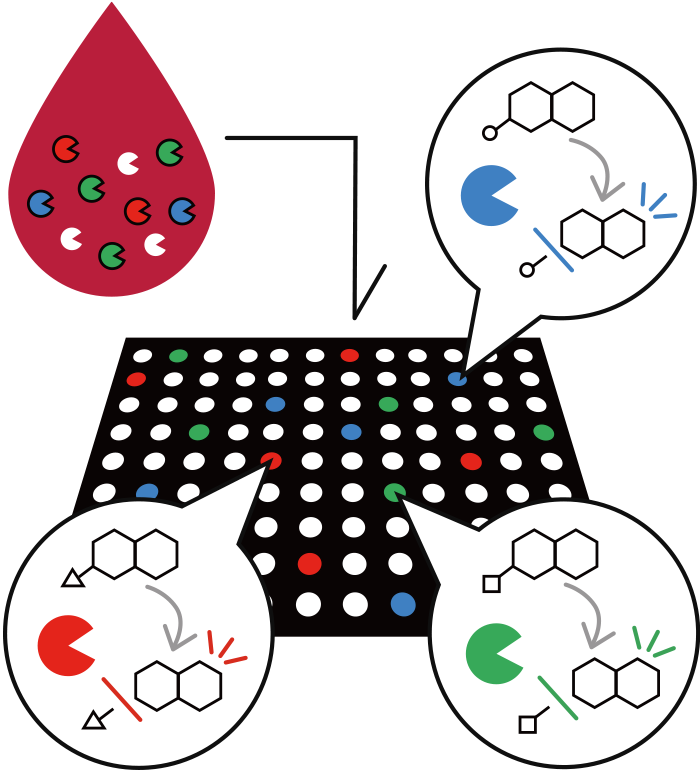
We can live well when our "cells" are working properly. Within cells are “proteins”, which consist of several types including enzymes. Enzymes play various important roles in “cells” function. For example, if the enzyme that acts as scissors cuts more substrates than usual, or, conversely, stops cutting at all, the cells will not work well. Often times, this change in enzyme activity is known to cause or worsen disease. Thus, we can accurately detect disease by evaluating the enzyme performance or activity at each enzyme level.


Single-molecule Enzyme Activity-Based Liquid Biopsy
STEP1)
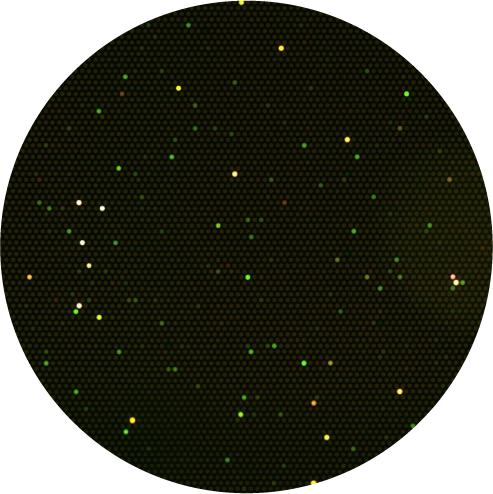
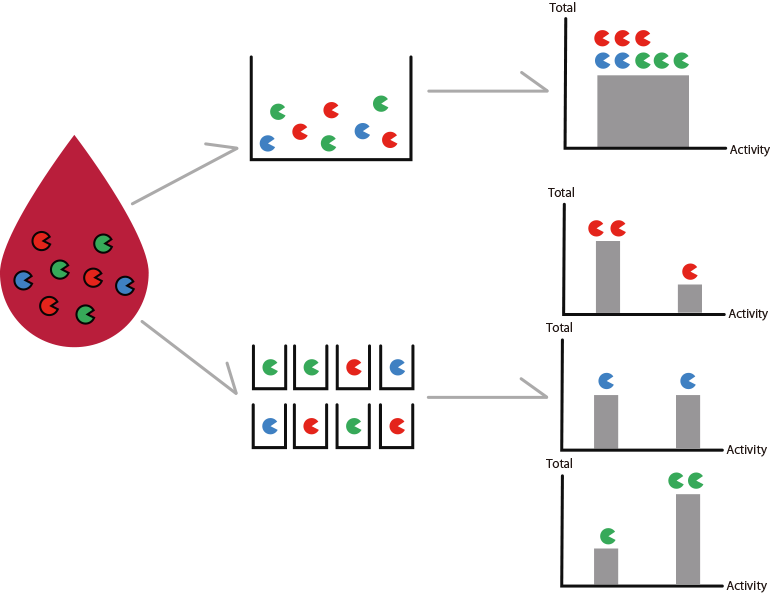
Diluted blood with multi-colored fluorescent enzyme substrates are added to a microdevice with numerous wells with a diameter of 3 µm. Probability wise, each well will include one or zero enzyme. The enzymes metabolize the fluorescent enzyme substrates, producing fluorescent material in the wells. Fluorescence microscopy provides fluorescent signals with an intensity corresponding to the activity of each enzyme.
STEP2)
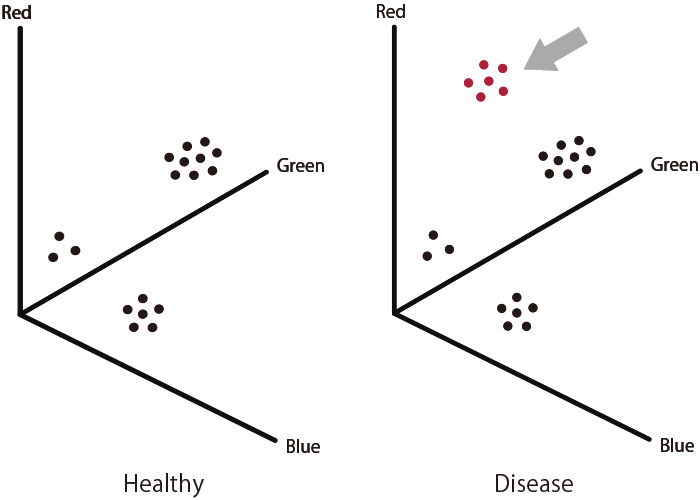
Diseases such as cancers are diagnosed based on difference in enzyme activity profiles, such as number of enzymes (based on number of glowing wells) and enzyme activity (fluorescence intensity of each color).
Fluorescent enzyme substrates (fluorescent probes)
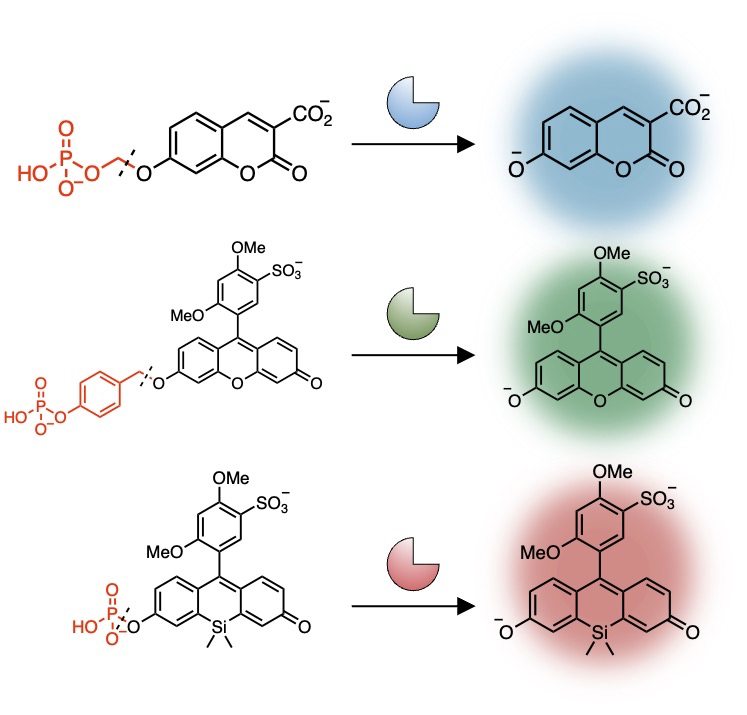
We designed and developed our own fluorescent enzyme substrates that fluoresce when metabolized by certain enzyme groups.
To date, more than 100 fluorescent enzyme substrates have been developed, including ALP (Alkaline phosphatases), ENPP (Ectonucleotide pyrophosphatases/phosphodiesterases), MMP (Matrix metalloproteinases), DPP (Dipeptidyl peptidases), Aminopeptidases, etc.
Enzyme subtypes can be distinguished by the differences in the enzyme reactivity to the fluorescent enzyme substrate of each color.
THREE ADVANTAGES
1. High predictive accuracy
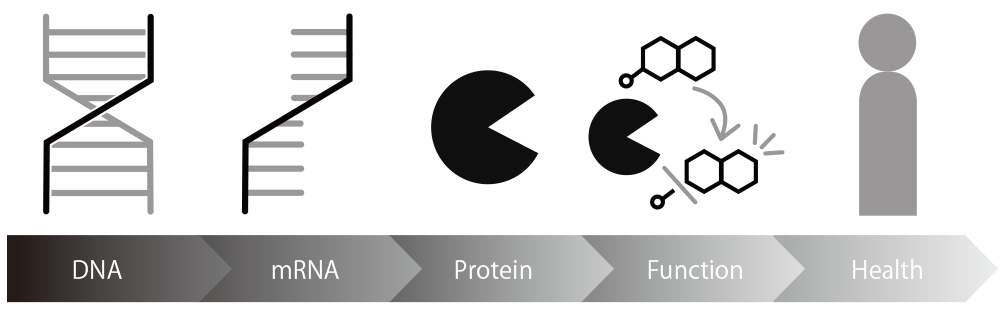
Existing diagnostics mostly detect proteins which include DNA, mRNA, and enzymes, but detecting the change levels of such proteins may not accurately capture changes in disease state.
Our technology utilizes "enzyme activity" which is directly related to cellular function and is thought to more accurately reflect the disease state as an indicator.
Diagnoses with high predictive accuracy is made possible by capturing the intensity of activity for each molecule of enzyme.
2. High detection sensitivity
For example, in the conventional ELISA method, 10 million enzymes are required for detection.
Our technology enables enzymes to be detected at single enzyme level with a microdevice, thus allowing for earlier diagnosis.
3. Detectable with less than a drop of blood
Since 1 µL of blood is sufficient for diagnosis, evaluation is possible with a very small amount of sample.

RESEARCH ACHIEVEMENTS
This study established the academic foundation of Cosomil’s technology and introduced Single-molecule Enzyme Activity Profiling (SEAP), a method for analyzing enzyme activity at the single-molecule level using fluorogenic substrates and microdevices. It demonstrated that multiple enzyme activities in blood can be detected and differentiated, and identified pancreatic cancer-associated alterations in ENPP3 activity clusters.
This University of Tokyo-led study developed fluorogenic substrates for detecting M3 metalloprotease activity and demonstrated elevated activity in colorectal cancer tissues and blood samples. The results support the broader applicability of SEAP-based liquid biopsy beyond pancreatic cancer.
This study applied SEAP to identify blood-based activity biomarkers for early-stage pancreatic cancer. Abnormal activities of enzymes such as DPP4 and CD13 were detected in Stage I–II patients, forming the scientific foundation of Cosomil’s diagnostic approach.
This study extended SEAP to oxidoreductases using NAD(P)H-responsive fluorogenic probes optimized for microdevice-based measurements. It demonstrated that oxidoreductase activity can be profiled in body fluids, expanding biomarker discovery beyond proteases.
This study developed an efficient solid-phase synthesis method for ProTide-based fluorogenic probes, enabling systematic profiling of carboxypeptidase activity. It identified pancreatic cancer-associated increases in this enzyme class, broadening the scope of SEAP-based biomarker discovery.
This study established an automated and highly reproducible platform for SEAP-based protease activity analysis in blood. The platform enables scalable data acquisition and supports the clinical development of activity-based diagnostics.
This University of Tokyo-led study developed SCCR (Synthesis based on Covalent Capture and Release), a purification-free automated synthesis method for fluorogenic probe libraries suitable for single-molecule protease activity analysis. By enabling the rapid generation of more than 100 fluorogenic probes, this work expands the chemical foundation for SEAP-based biomarker discovery.